

Blast from the Past: This entry first appeared on August 19, 2018, and was reposted on October 3, 2026. The reason for reposting is because research on the pedagogical value of morphology teaching continues to burgeon. What might have been a forward-thinking article in 2018, seems obvious in 2026. That’s if one pays attention to the studies showing the positive impact that morphology instruction has on students’ abilities to recognize and spell words and to comprehend text throughout the grades (for both older and younger children). The only big change to this entry is the inclusion of a list of relevant meta-analyses and reviews of research and recent studies on morphology instruction.
Teacher question:
Are there any resources that provide a list of morphemes to teach at each K-5 grade level? I have been looking for a definitive list of morphemes that is organized by grade level like the Fry sight word list. I often come across research about how L1 and L2 students acquire morphemes, but I am looking for a list that represents the morphemes that students will most likely see in print at each K-5 grade level. Does anything like that exist? Thank you for your time.
Shanahan response:
The short answer to this question is, “No, I don’t know of such a list.”
But when have I ever been satisfied with the short answer to anything?
Let’s make sure we’re all in agreement as to what constitutes a morpheme? A morpheme is the “smallest grammatical unit.” It isn’t the same thing as a word, and yet many words are morphemes. The distinction turns on whether the unit (the morpheme or word) can stand on its own. Words must have that kind of independence, while morphemes don’t require it.
Thus, bags, trucked, running, and redirect are all words in the English language while bag, s, truck, ed, run, ing, re, and direct are all morphemes. Each morphemic unit carries meaning, but sometimes morphemes can do that independently (bag, truck, run, direct), and sometimes they need to be combined with other morphemes to be considered a word (s, ed, ing, re).
I was unsure how to answer your question. So, I admitted ignorance and turned that to advantage. I contacted Jeffrey and Peter Bowers. Both are outstanding scholars (Jeff at the University of Bristol in the UK, and Peter at WordWorks Literacy Centre, in Ontario) who are particularly knowledgeable about teaching morphology to improve literacy. They’ve both published widely on the issue, and both have chided me when they felt I wasn’t paying sufficient attention to how words work morphologically. Below I’ve included some graphics that they provided, and you can go the WordWorks website to see them in their full glory.
http://www.wordworkskingston.com/WordWorks/Home.html
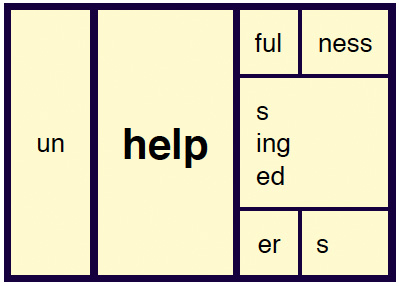
Word Matrix: A map of a word family
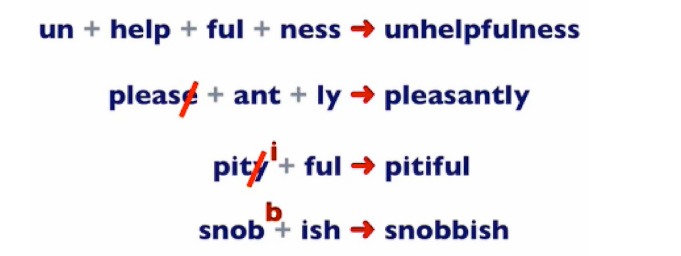
Word Sums: reveal underlying structure of any complex word (a word with more than just a base)
Here is Peter Bower’s response (with my light editing):
“I have no knowledge of such a list, but I wouldn’t recommend one anyway.
“My recommendation based on theory not direct research evidence — is that the main value comes from teaching all or many members of a morphological family at one time with the matrix and word sums (see the attached figure illustrating a matrix and word sum). In the younger grades I start with free bases [those morphemes that stand alone as words], but once that is established, I have no trouble introducing bound bases [the units that can’t stand alone]. This relates to the research we cite about the value of studying meaningfully related items at one time rather than disconnected items.
“Instead of a “scope and sequence” of morphemes to teach, what I recommend is starting with words in the children’s vocabulary, analyzing such words to find their bases, then looking for other members of that family.
“The point is not that there is a “scope and sequence” of morphemes to teach. Rather there is a kind of a “scope” of orthographic concepts that we want students to learn, and teachers can address those concepts based on whatever words are central to the readings they are introducing to the students.
“A brief list of those concepts that should be taught would include:
- Every word is a base or a base with something else (another base or affix).
- Bases and affixes (morphemes) are the meaningful building blocks that construct words.
- We can analyze complex words into constituent morphemes with word sums and show their interrelationship with a matrix.
- English spelling prioritizes consistent spelling of morphemes over consistent pronunciation of morphemes. (This is why we refer to morphemes by their spelling not their pronunciation. The base of the word action is not referred to by the pronunciation of the word act. Instead, it is referred to by its spelling. The base “a - c - t”. This is the same as the fact that we don’t refer to the <-ed> suffix by one or all its three pronunciations, we call it by its spelling “e-d suffix.")
- Thus, we need to understand grapheme-phoneme correspondences from within the context of morphological families. (e.g. we learn the phonology of the grapheme by studying morphological families). https://tinyurl.com/y8kxh4ag
- There are reliable conventions for the three suffixing conventions.
- Studying and understanding the suffixing conventions is not primarily about improving spelling accuracy, it is about being able to analyze hypotheses about connections between words. We can test the hypothesis that "imagine" has a base "image" only if we know vowel suffixes replace final, non-syllabic "e" (image/ + ine —> imagine).
- The “structure and meaning test”: To determine that two words share a base, we need evidence from both structure (word sum) and meaning (etymology). With the example of words related to "play" (play, playing, playful, replay, playhouse), we can prove all those words can be analyzed with word sums with coherent affixes and bases. But we can also show that they all go back to an Old English root plegan, plegian for “frolic, move rapidly”. However, the word "display" which can be analyzed structurally turns out not to be related. It does not belong in the morphological family with the others because it goes back to a Latin root plic(ere) for “fold”. To “display” is to “unfold”.
“If we are going to teach children how their writing system works, we need to teach them the interrelation of morphology, phonology, and etymology. As we have pointed out, this is why Structured Word Inquiry (SWI) is not about “adding” morphological instruction to phonics instruction — it’s about teaching how the system works. This is why I argue that SWI teaches grapheme-phoneme correspondences more explicitly and accurately than phonics. Phonics instruction (under the definition of associations of pronunciations and letters without reference to morphology or etymology) cannot explain the grapheme-phoneme correspondences in countless words like does or rough or every or homophones, and so on. So many people miss the absolute detail into orthographic phonology that comes with SWI.
“Here are some videos to illustrate my point:
- Gr. 2 teacher showing investigations from his class Grade 2 morphology video
- Investigating grapheme-phoneme correspondences in a Gr. 1 class — with the context of morphological word sums Grade 1 morphology video
- A kindergarten lesson I taught introducing the word sum and matrix that touches on grapheme-phoneme correspondences like the pronunciation of the <-s> suffix for /z/ and /s/ Kindergarten morphology video
“It’s as simple as starting with the “known” and then expanding from that. Even if kids know all the words in a morphological family (e.g. play, playing, playful, replay, playhouse) the lesson is not about new vocabulary, but learning how word structure links words. That concept can then be applied anywhere.
“The other thing I keep in mind when choosing morphological families to investigate is the orthographic concepts a family has to offer. If I’ve established the fact that words that share a base share a spelling and a meaning connection, then I can introduce a base with words like actor, acting, react, and action to introduce the fact that the pronunciation of morpheme might change but keep the spelling. In that way we learn the phonology of t is not the “t sound,” but that the t grapheme can signal the /t/ when that is the appropriate sound.
“I also draw on the <-ed> suffix from early on to highlight this same concept that morphemes do not have pronunciations until they are in a word. The pronunciation of a word like “asked” is another useful one to get rid of this idea of a “t sound” since this very common pronunciation of a very common suffix is what is typically thought of the “t sound,” but their ain’t no t!
“And then you also encounter words that give rise to the need to teach all the suffixing changes.
“These are concepts teachers need to learn, and they can bring into work with their class as they investigate words.”
Shanahan again:
I don’t disagree with Peter on this overall, though I see more benefit of starting with simple phonics and working towards morphology and I’m not quite as dismissive of the kind of list that this teacher requested – even if that list focused on a set of base words for each grade. I don’t see that guidance as mutually exclusive from the curriculum goals that Peter argues for or necessarily contradictory of the kind of instruction he described.
Many teachers, when referring to morphology or “structural analysis,” are talking about affixes alone, and not the bases. Just the opposite of what Peter is proposing and there are lists which present the most common prefixes and suffixes from textbooks in grades 3-9 (White, Sowell, & Yanagihara, 1989). You can easily find such lists online and you could make good use of those lists to make sure that you are hitting all the right notes using Peter’s word sums and matrixes.
For instruction to be effective, teachers require two types of knowledge. They need to have the kinds of pedagogical knowledge described here, so that they will know how to engage their students with morphology in effective ways. They also need relevant content knowledge, and it seems clear that many teachers don’t know much about this aspect of our language (Dilgard & Hodges, 2026). This is an area where teachers would benefit greatly from clear curriculum guides, including the kinds of lists that you requested – even if those lists may turn out to be a bit more complicated than you anticipated.
References
Bratlie, S. S., Brinchmann, E. I., Melby-Lervåg, M., & Torkildsen, J. v. K. (2022). Morphology—A gateway to advanced language: Meta-analysis of morphological knowledge in language-minority children. Review of Educational Research, 92(4), 614-650. https://doi.org/10.3102/00346543211073186
Bowers, P. N., Kirby, J. R., & Deacon, S. H. (2010). The effects of morphological instruction on literacy skills: A systematic review of the literature. Review of Educational Research, 80(2), 144-179. https://doi.org/10.3102/0034654309359353
Broc, L., Joye, N., Dockrell, J. E., & Olive, T. (2021). Capturing the nature of the spelling errors in developmental language disorder: A scoping review. Language, Speech, and Hearing Services in Schools, 52(4), 1127-1140. https://doi.org/10.1044/2021_LSHSS-20-00086
Deacon, S. H., & Levesque, K. (2024). Mechanisms in the relation between morphological awareness and the development of reading comprehension. Journal of Educational Psychology, 116(6), 1052-1069. https://doi.org/10.1037/edu0000871
Dilgard, C., & Hodges, T. S. (2026). Digging deeper to unpack the current trends of teachers’ morphology content and pedagogical knowledge. Reading and Writing: An Interdisciplinary Journal, 39(5), 1785-1806. https://doi.org/10.1007/s11145-025-10672-6
Colenbrander, D., von Hagen, A., Kohnen, S., Wegener, S., Ko, K., Beyersmann, E., . . . Castles, A. (2024). The effects of morphological instruction on literacy outcomes for children in English-speaking countries: A systematic review and meta-analysis. Educational Psychology Review, 36(4), 119. https://doi.org/10.1007/s10648-024-09953-3
Georgiou, G. K., Vieira, A. P. A., Rothou, K. M., Kirby, J. R., Antoniuk, A., Martinez, D., & Guo, K. (2023). A meta-analysis of morphological awareness deficits in developmental dyslexia. Scientific Studies of Reading, 27(3), 253-271. https://doi.org/10.1080/10888438.2022.2155524
Goodwin, A. P., & Ahn, S. (2010). A meta-analysis of morphological interventions: Effects on literacy achievement of children with literacy difficulties. Bulletin of the Orton Society, 60(2), 183-208. https://doi.org/10.1007/s11881-010-0041-x
Goodwin, A. P., & Ahn, S. (2013). A meta-analysis of morphological interventions in english: Effects on literacy outcomes for school-age children. Scientific Studies of Reading, 17(4), 257-285. https://doi.org/10.1080/10888438.2012.689791
Lee, J. w., Wolters, A., & Grace Kim, Y. (2023). The relations of morphological awareness with language and literacy skills vary depending on orthographic depth and nature of morphological awareness. Review of Educational Research, 93(4), 528-558. https://doi.org/10.3102/00346543221123816
Silverman, R. D., Johnson, E., Keane, K., & Khanna, S. (2020). Beyond decoding: A meta?analysis of the effects of language comprehension interventions on K–5 students’ language and literacy outcomes. Reading Research Quarterly, 55, S207-S233. https://doi.org/10.1002/rrq.346
Traga Philippakos, Z. A., Quinn, M. F., & Rocconi, L. (2025). Multisyllabic instruction for upper elementary learners: A pilot study exploring feasibility and effectiveness. Journal of Research in Childhood Education, 40(3), 468-491. https://doi.org/10.1080/02568543.2025.2465585
Zhang, D., Ke, S. (., & Mo, Y. (2023). Morphology in reading comprehension among school-aged readers of English: A synthesis and meta-analytic structural equation modeling study. Journal of Educational Psychology, 115(5), 683-699. https://doi.org/10.1037/edu0000797




Comments
See what others have to say about this topic.